Private office or renting your own: which really costs less?
In business today, companies face many decisions when it comes to choosing the right place to work. One important question is whether to take a private office, often offered in flex offices or coworking spaces, or a traditional office. What advantages does each form offer, where do they differ, and what actually matters?
Cost: private offices vs. conventional offices
Cost is often the decisive factor when choosing where to work. Private offices in coworking spaces are generally cheaper than traditional office rents. That is particularly useful for small companies and start-ups. A conventional office for five people can cost around EUR 120,556 over three years, for example, while a private office in a coworking space costs only about EUR 93,900 — a saving of some EUR 26,600 on rent alone.
In cheaper cities the difference can be even starker. A conventional office can cost up to EUR 73,377.30, while a private coworking office costs only EUR 40,700. That is a difference of almost EUR 33,000 over three years.
The real difference in price is in the detail
At first glance conventional offices sometimes do not look all that much more expensive, particularly if you compare the price per square metre. But that impression is misleading, because the rent quoted is almost always the net cold rent — the base rent and nothing else.
In practice the following hidden extra costs soon come on top:
Operating and running costs (water, waste, communal electricity and so on)
Electricity and heating/air conditioning for the space you rent
Cleaning services (regular office cleaning)
Internet and IT infrastructure
Coffee machine, water, office supplies
Furniture and maintenance
All these costs have to be organised and paid for yourself, which is not only expensive but time-consuming — particularly for small teams with no office manager.
In a private office in a coworking space, by contrast, all of that is already in the price or can be added relatively cheaply.
Cost per month | Own office (4 people) | Private office (4 people) |
|---|---|---|
Base rent (net) | EUR 1,360 | EUR 1,956 |
Running costs (operating costs etc.) | EUR 204 | EUR 0 |
Electricity and heating | EUR 340 | EUR 0 |
Cleaning | EUR 253 | EUR 0 |
Internet | EUR 99 | EUR 0 |
Coffee/tea and office supplies | EUR 127 | EUR 0 |
Total monthly costs | EUR 2,583 | EUR 1,956 |
One-off costs | ||
Agent's commission (one-off) | EUR 4,896 | EUR 0 |
Deposit (one-off) | EUR 9,792 | EUR 2,347 |
Fit-out | EUR 13,600 | EUR 0 |
Total costs (one-off) | EUR 28,288 | EUR 2,347 |
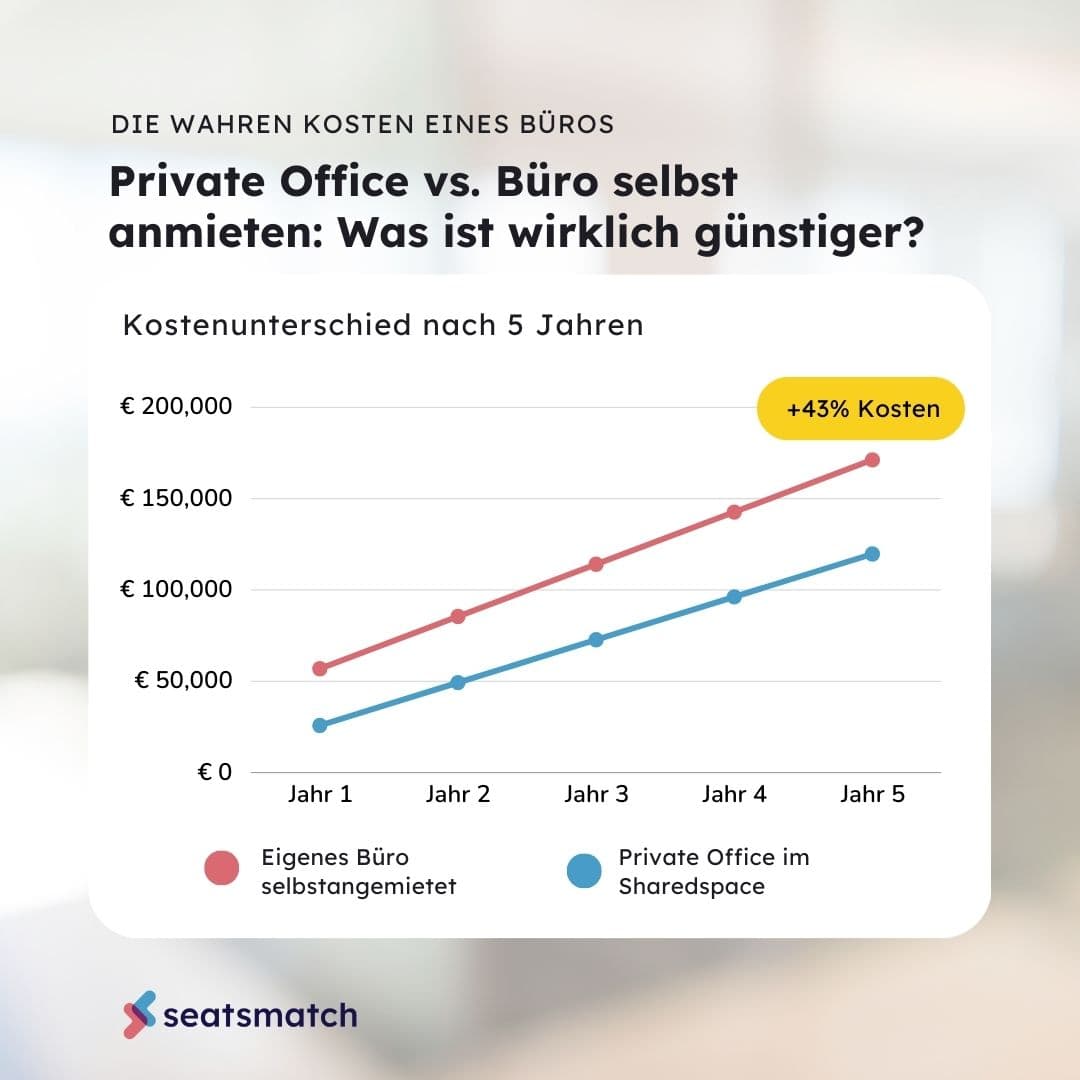
Your own office: up to 43 per cent more expensive after 5 years.

Besides the higher initial costs of your own office for 4 people, it is above all the higher monthly costs that make it on average 43 per cent more expensive over five years than an all-inclusive private office. That said, the more employees you have, the cheaper renting your own office becomes.
Not to be forgotten: agent's fees, deposit and long commitments
Besides the rent itself, conventional office lettings often bring further, considerable costs:
Agents' commission on commercial property is usually around 3 months' gross rent.
On top of that a deposit of between 3 and 6 months' gross rent is usually required, which quickly means a high capital requirement — before anyone has even moved in.
Then there are often waivers of the right to terminate for 3 to 5 years, which mean a long-term commitment and leave hardly any flexibility.
Costs in summary
Conventional office: higher monthly costs, large initial outlay
Private office: cheaper, less capital tied up
Flexibility: the advantages of coworking spaces
Flexibility is another decisive factor in choosing where to work. Coworking spaces let companies react flexibly to changes in their size. As the company grows or shrinks, it can easily rent more or less space. Conventional offices, by contrast, often offer only fixed space with long leases and less room to adapt.
Private offices in coworking spaces combine the advantages of privacy with the flexibility coworking offers. Companies can benefit from a short notice period, which makes it easier to adapt to market conditions.
Use of space and how much room you get
How space is used is another important point. In conventional offices and private offices, employees generally have more room — about 10–15 m² per person, compared with only 4–5 m² per person in open-plan spaces. That encourages not only comfort but productivity, since people work in less crowded surroundings. That said, space and infrastructure can often be shared in private offices. Several companies can share the kitchen, washrooms and corridors, as well as printers, scanners and internet, which reduces the total space needed considerably. Communal areas often account for as much as 50 per cent of office premises.
Space compared
Conventional office: 10–15 m² per person
Private office: 10–15 m² per person
Open-plan: 4–5 m² per person
Additional services and infrastructure
Another advantage of coworking spaces is the additional services often included in the rent — internet, cleaning, conference rooms and other shared infrastructure. In a conventional office these services generally have to be organised and paid for separately, which brings extra cost and effort.
Who benefits from private offices?
Private offices and flexible office solutions are particularly suited to:
Start-ups and the self-employed with an uncertain or growing headcount
Companies that want planning certainty without entering long-term commitments
Companies looking for flexibility and cost efficiency
Conventional offices, on the other hand, are ideal for established companies that value exclusivity and control over their whole space.
Advantages and disadvantages at a glance
Feature | Conventional office | Private office (coworking) |
|---|---|---|
Cost | Higher, large initial outlay | Cheaper, less capital tied up |
Flexibility | Low, long contracts | High, can be ended at short notice |
Additional services | Usually to be organised separately | Many services included |
Room to grow | Hard to scale | Easily adapted |
Privacy | High | High, but infrastructure is shared |
Space per person | 10–15 m² | 10–15 m² |
Who it suits | Established companies | Start-ups, flexible teams, freelancers |
In conclusion: the best choice for your company
In summary, private offices in coworking spaces offer small companies and start-ups above all a cheaper and more flexible alternative to the conventional office. They combine privacy with the infrastructure and services of a coworking space and allow companies to grow without much effort while cutting monthly fixed costs considerably. Only companies with very specific requirements, or those that place particular value on exclusivity and brand presence, still benefit from a conventional office.
If you are looking for a flexible, cost-efficient answer for your company, it is worth considering the advantages of private offices in coworking spaces. Explore your options and find the ideal place to work for what you need.