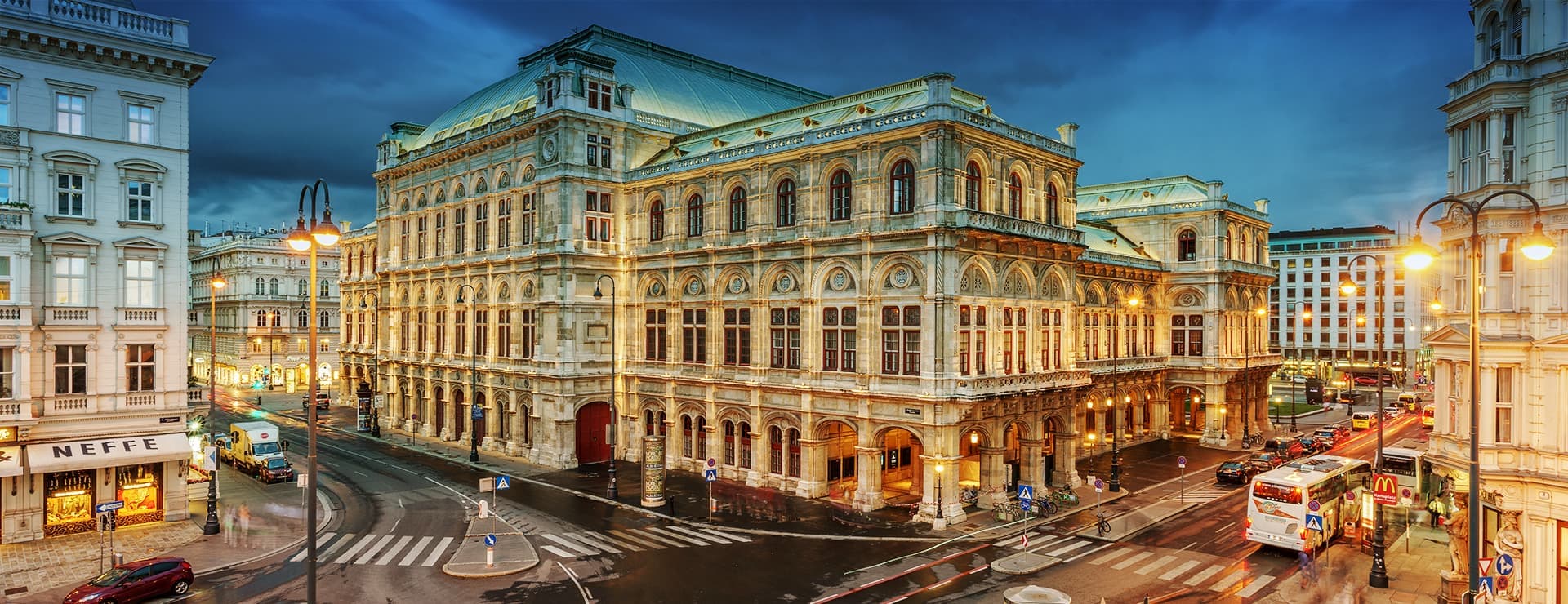
Vienna's Ringstraße is among the most magnificent boulevards in Europe and is home to some of the city's most impressive buildings.
1. The Vienna State Opera – the city's musical landmark
The Vienna State Opera is one of the best-known buildings on the Ringstraße and a landmark of Austrian musical culture. Since it opened in 1869 it has been among the world's leading opera houses and draws music lovers from around the world every year. The magnificent building stands for the highest artistic quality and a long tradition of first-class performances.
When did the Vienna State Opera open?The Vienna State Opera opened ceremonially on 25 May 1869 with a performance of Mozart's Don Giovanni.

Architecture and design
The Vienna State Opera was designed by the architects August Sicard von Sicardsburg and Eduard van der Nüll in the neo-Renaissance style. The impressive façade is marked by round arches, elaborate reliefs and finely worked sculpture. Inside, gilded stucco ceilings, a magnificent marble staircase and splendid ceiling paintings by Franz Dobiaschofsky make their impression. The auditorium is particularly imposing, with its red velvet seats and the great chandelier that bathes the whole house in warm light.
A neo-Renaissance façade with richly detailed reliefs
An impressive marble staircase with statues of the muses
Splendid ceiling paintings by Franz Dobiaschofsky
Historical significance
The Vienna State Opera was one of the first buildings erected as part of the Ringstraße project. Mozart's "Don Giovanni" was played at the opening, a sign of Vienna's musical standing. The building was received critically at first, because the street level turned out higher than planned, which made it look lower than intended. That earned it the mocking name "the Königgrätz of architecture".
During the Second World War the opera was badly damaged in a bombing raid in 1945. Large parts of the auditorium and the stage burned down. Only in 1955, after extensive rebuilding, could the house reopen with Beethoven's "Fidelio". Since then the Vienna State Opera has established itself as one of the most significant cultural institutions in the world.
The building today
Today the Vienna State Opera is among the most visited opera houses in the world. It offers more than 350 performances a year, among them works by Mozart, Verdi and Wagner. Particularly famous is the Vienna Opera Ball, which draws international guests every year.
📍 Address: Opernring 2, 1010 Vienna
🕒 Opening hours: Guided tours daily at 10:00 and 14:00
🎟 Tickets: Online on the official website or at the box office in the evening
Particular features and highlights
🎭 Live broadcasts: In summer, performances are broadcast free on a large LED screen in front of the opera house
🎼 Children's opera: A dedicated programme for young opera lovers
💎 The Opera Ball: Austria's most glamorous ball, with 5,000 guests
2. The Austrian parliament – the political heart of the country
The Austrian parliament building is one of the most impressive structures on Vienna's Ringstraße and the centre of Austrian democracy. Since it opened in 1883 it has been the seat of the National Council and the Federal Council, and so the most important place for political decisions in Austria. The imposing neoclassical building deliberately recalls the architecture of ancient Greece and symbolises the country's democratic values.
When was the Austrian parliament built?Construction began in 1874 and was completed in 1883 under the architect Theophil von Hansen.

Architecture and design
The parliament building was designed by Theophil von Hansen in the neoclassical style. Inspired by Greek temples, it is adorned with monumental columns, sweeping staircases and richly detailed friezes. Particularly striking is the statue of Pallas Athene in front of the main portal, standing for wisdom and democracy. Inside, richly decorated chambers, finely worked ceiling paintings and an imposing dome give the building an atmosphere all its own.
A neoclassical design with Doric and Ionic columns
The Pallas Athene fountain as a symbol of wisdom and democracy
Splendid chambers with elaborate wood panelling and gilding
Historical significance
The parliament building went up at a time when constitutional monarchy was gaining influence in Austria. The building was meant to underline the idea of a modern, democratic society, and was therefore built in the style of Greek antiquity — a deliberate allusion to the cradle of democracy.
During the Second World War the building suffered considerable damage from bombing. After the war it was restored step by step and has remained the symbol of Austria's political independence to this day. Between 2017 and 2023 the parliament building was extensively renovated and fitted with the latest technology to meet the demands of contemporary lawmaking.
The building today
Today parliament is the seat of the Austrian National Council and Federal Council, where important laws are passed. Following the extensive renovation, the building offers state-of-the-art chambers, digital voting systems and an interactive visitor centre. The public tours, on which visitors get an insight into parliamentary work and can see historic rooms, are particularly popular.
In the immediate vicinity of parliament there are numerous coworking spaces in Vienna offering inspiring surroundings for freelancers and start-ups — perfect for anyone who wants to work in the middle of the political centre.
📍 Address: Dr.-Karl-Renner-Ring 3, 1017 Vienna
🕒 Opening hours: Guided tours daily at 11:00 and 15:00
🎟 Admission: Free for visitor groups booking in advance
Particular features and highlights
🏛 Tours for visitors: Public tours through the historic rooms and the National Council chamber
📜 Democracy in the open: Visitors can follow plenary sittings live
🌍 Modernisation: A sustainable refurbishment with energy-efficient lighting and new media technology
The Burgtheater – the stage of the great dramas
The Burgtheater is the most significant German-language theatre and one of the most famous stages in Europe. It opened on Vienna's Ringstraße in 1888 and has been one of the city's cultural landmarks ever since. With its elaborately designed halls, magnificent façade and first-class ensemble, the theatre draws thousands of visitors every year. The mix of classical and modern theatre makes the Burgtheater one of the most important institutions in the performing arts.
When did the Burgtheater open?The present Burgtheater building opened ceremonially on 14 October 1888.

Architecture and design
The Burgtheater was designed by the architects Gottfried Semper and Carl von Hasenauer and built in the style of the Italian High Renaissance. The striking façade is adorned with finely worked sculpture, columns and reliefs. Inside, opulent ceiling paintings by Gustav and Ernst Klimt, a magnificent marble staircase and an auditorium lined in red velvet create an atmosphere all its own.
A façade in the style of the Italian High Renaissance with richly detailed reliefs
Ceiling paintings by Gustav Klimt in the stairwell
A magnificent marble staircase leading into the auditorium
Historical significance
The Burgtheater's history goes back to 1741, when Empress Maria Theresa had the first venue built as an imperial court theatre. Over the centuries the theatre developed into one of the leading stages in Europe.
The present building on the Ringstraße opened in 1888 and set new standards for theatre construction. The Burgtheater is particularly famous for its acting tradition and the legendary "Burgtheater diction", regarded as the standard for elevated stage German. During the Second World War the theatre was badly damaged by bombing, but was restored faithfully in the 1950s.
The building today
Today the Burgtheater is one of Europe's leading stages and known for its first-class productions. The repertoire ranges from classical works by Shakespeare, Goethe and Schiller through to contemporary drama. Alongside the regular performances there are premieres, readings and special events on a regular basis.
📍 Address: Universitätsring 2, 1010 Vienna
🕒 Performance times: Depending on the production; the current programme is on the website
🎟 Tickets: Bookable online, at the box office or by phone
Particular features and highlights
🎭 Burgtheater tours: A look behind the scenes with insights into the historic architecture
🎨 The Klimt frescoes: The famous ceiling paintings are an artistic highlight of Vienna's Ringstraße
🎤 Internationally known actors: Many Burgtheater performers are successful in film and television too
4. The Kunsthistorisches Museum – Vienna's treasury of art
The Kunsthistorisches Museum in Vienna is among the most significant museums in the world and holds one of the most valuable art collections in Europe. Since it opened in 1891 it has fascinated visitors with masterpieces by artists such as Vermeer, Rubens and Caravaggio. The magnificent building on Vienna's Ringstraße was built specifically to house the Habsburg art collections and is today a magnet for lovers of art and culture.
When did the Kunsthistorisches Museum open?The museum was officially opened by Emperor Franz Joseph on 17 October 1891.

Architecture and design
The Kunsthistorisches Museum was built by Gottfried Semper and Carl von Hasenauer in the neo-Renaissance style. Its imposing dome, symmetrical architecture and magnificently decorated halls make it one of the most impressive museum buildings in the world. Inside, splendid marble columns, gilded stucco work and striking ceiling frescoes delight the eye. Particularly spectacular is the magnificent main staircase, adorned with paintings by Gustav Klimt.
A neo-Renaissance façade with a monumental dome
A magnificent marble staircase with Klimt frescoes
A symmetrical design mirroring the Naturhistorisches Museum opposite
Historical significance
The museum was built to present the extensive art collections of the Habsburg monarchy. Emperor Franz Joseph had it built as part of a large-scale urban development project intended to strengthen Vienna's position as a cultural centre of Europe.
The collections span five centuries and include the world-famous picture gallery, which holds one of the most significant collections of old masters. Over the decades the museum has become one of the most important custodians of European art history.
The building today
Today the Kunsthistorisches Museum is among the most visited museums in Austria. It houses not only one of the largest painting collections in the world but an impressive collection of antiquities, the Kunstkammer with its extraordinary exhibits, and a collection of historic coins. Alongside the permanent and special exhibitions there are events, lectures and exclusive tours on a regular basis.
📍 Address: Maria-Theresien-Platz, 1010 Vienna
🕒 Opening hours: Daily except Monday, 10:00–18:00, Thursday until 21:00
🎟 Tickets: Online or at the museum box office
Particular features and highlights
🖼 Masterpieces by great artists: Works by Rembrandt, Velázquez, Vermeer and Rubens
🎨 Gustav Klimt frescoes: A hidden highlight of the museum, on the main staircase
🏺 Kunstkammer Wien: A fascinating collection of historic curiosities from the Habsburg era
5. The Naturhistorisches Museum – a journey through the earth's history
The Naturhistorisches Museum in Vienna is one of the most significant natural history museums in the world. Since it opened in 1889 it has drawn visitors with impressive exhibits from archaeology, palaeontology and zoology. The museum is particularly famous for its comprehensive mineral collection, its dinosaur skeletons and the world-famous Venus of Willendorf.
When did the Naturhistorisches Museum open?The museum opened ceremonially on 10 August 1889.

Architecture and design
The museum was designed at the same time as the Kunsthistorisches Museum opposite, by Gottfried Semper and Carl von Hasenauer, in the neo-Renaissance style. The façade, with its imposing sculpture and columns, gives the building a majestic appearance. The interior impresses with finely worked ceiling paintings, magnificent marble floors and generous exhibition rooms, elaborately designed to show the exhibits to best effect.
A neo-Renaissance façade with rich decoration
A main staircase with impressive frescoes
A mirror image of the Kunsthistorisches Museum, but with an interior all its own
Historical significance
The Naturhistorisches Museum grew out of the Habsburg scientific collections, assembled over centuries. The collections go back to the 18th century and include rare fossils, gemstones and zoological specimens.
The museum became particularly famous through the display of the Venus of Willendorf, a statuette some 29,500 years old that is regarded as one of the best-known archaeological finds in Europe. Over the decades the museum has developed into a central research institution for palaeontology, mineralogy and anthropology.
The building today
Today the Naturhistorisches Museum is one of the most visited scientific institutions in Vienna. Besides the permanent exhibition, which covers more than 30 million objects, there are interactive stations, 3D models and special tours for children and families. The digital planetarium, which offers fascinating insights into the universe, is particularly popular.
📍 Address: Maria-Theresien-Platz, 1010 Vienna
🕒 Opening hours: Wednesday–Monday, 9:00–18:30, Thursday until 21:00
🎟 Tickets: Online or at the museum box office
Particular features and highlights
🦖 The dinosaur hall: One of the largest and best-preserved dinosaur skeletons in Europe
🪨 The mineral and gemstone collection: More than 100,000 rare stones, among them the world-famous topaz weighing over 117 kg
🛸 The digital planetarium: Fascinating animations about the universe
Related Articles

Flexible work in Europe 2025: a comprehensive case study
Hybrid work dominates the European world of work. Companies benefit from better talent retention and more efficient use of space. Employees gain time and autonomy. The data shows a market that has matured, with rising demand for coworking and digitally supported ways of working.
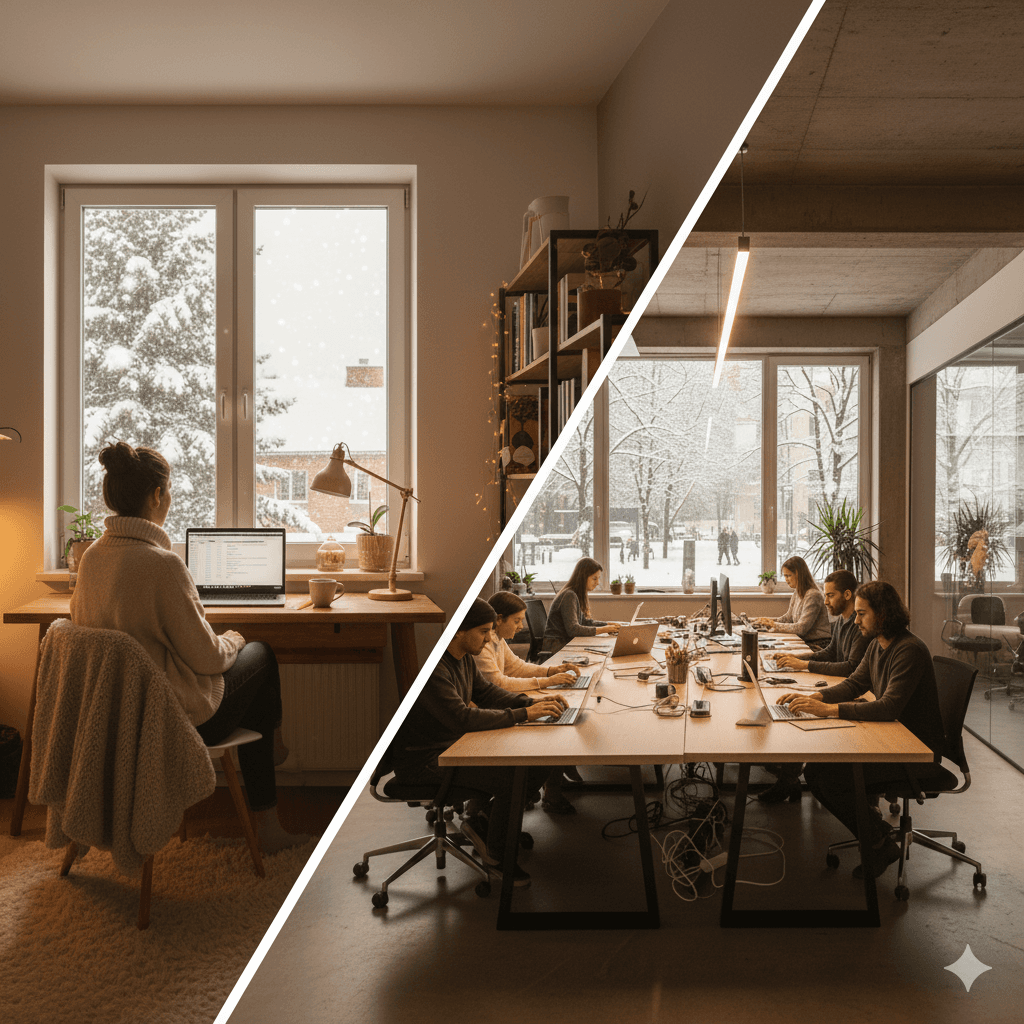
The cost advantages of a private office or coworking space in winter
Winter 2025 brings an unprecedented wave of costs for companies, freelancers and employees working from home.
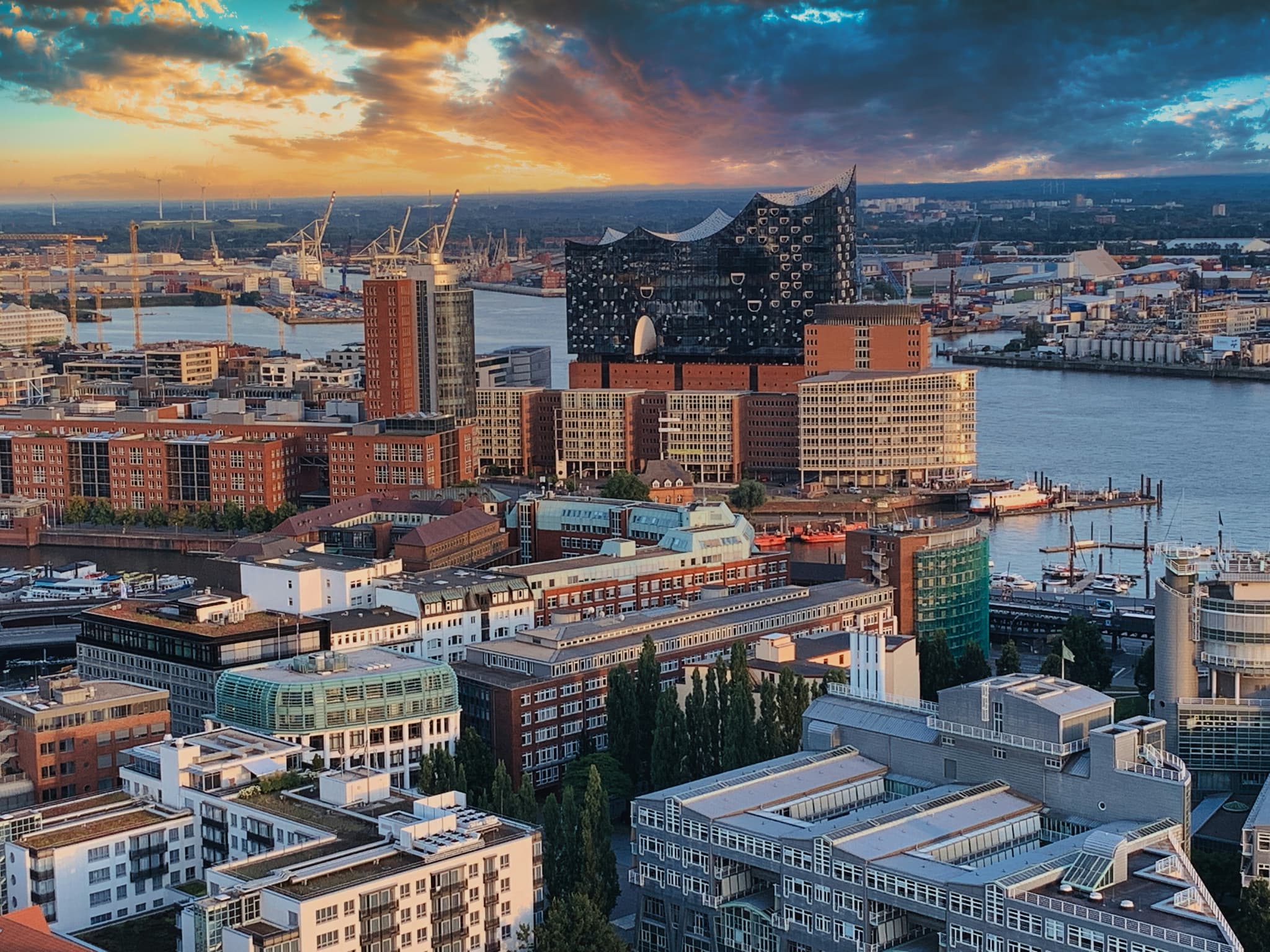
Renting an office in Hamburg 2025: rents, best locations and tips
Hamburg is one of the most interesting office markets in Germany. City centre, HafenCity or City-Süd: find out which locations offer the best opportunities in 2025, what rents look like and what to watch for in a contract.