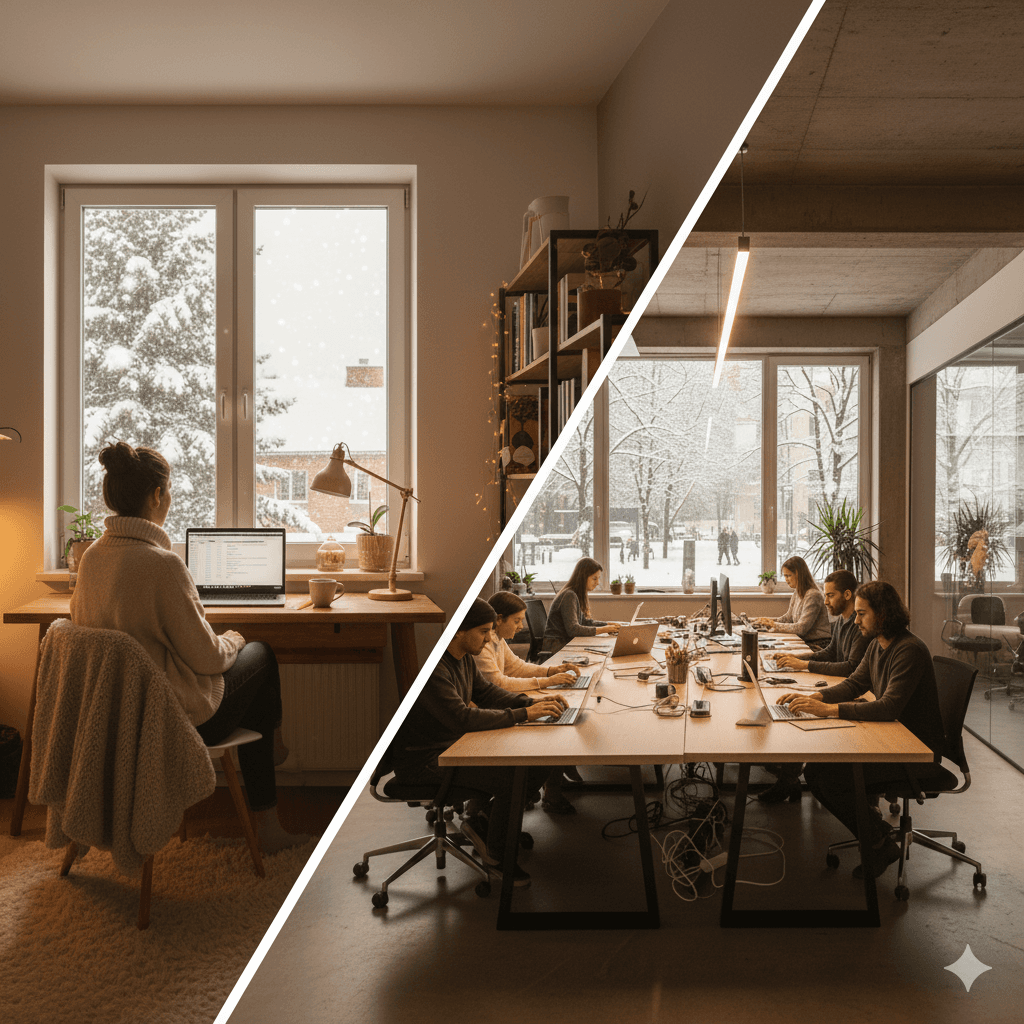
With energy subsidies running out and heating costs climbing, the decisive question is this: where can you work most cheaply and most efficiently? The answer is not the study at home but intelligent office solutions that share costs and use resources well.
Flexible workplaces in coworking spaces and shared offices offer not only financial advantages but professional infrastructure without the burden of high running costs. While the energy crisis of 2025 leaves people working from home with an average of EUR 265 in additional winter costs, shared workspaces make savings of up to 40 per cent possible compared with traditional office solutions.
The energy crisis of 2025 and what it means for office costs
Energy subsidies running out, prices going up
2025 marks a turning point in European energy policy. With the electricity price cap expiring, consumers no longer pay the subsidised 10 cents for the first 2,900 kilowatt hours but the full market price. At the same time grid tariffs are rising sharply — in Upper Austria by 31.9 per cent for electricity and 29.4 per cent for gas.
The effects are dramatic. The carbon price rises from EUR 45 to EUR 55 per tonne, while the electricity levy goes up from EUR 0.001 to EUR 0.015 per kilowatt hour — a fifteenfold increase. This hits companies and the self-employed particularly hard, since they had until now benefited from state relief measures.
These developments are documented in detail by the Vienna Energy Agency and in the EU action plan for affordable energy.
Heating costs per square metre compared
Current heating costs per square metre vary considerably by energy source. A condensing gas boiler causes average annual heating costs of EUR 11.70 per square metre, while district heating comes to EUR 13.80. Air-to-water heat pumps are the most expensive, at up to EUR 25 per square metre where consumption is high.

Offices in Hamburg benefit from the regional district heating infrastructure, while coworking spaces in Vienna offer advantages through modern heating systems and shared costs.
These figures come from the analysis of heating costs per square metre in 2025 and from the Vienna Energy Agency.
Germany vs. Austria: the regional differences
The regional differences in energy costs are considerable. While German companies face the complete expiry of energy support, Austria is opting for targeted support for energy-intensive businesses. That makes shared office solutions more attractive in both countries, since spreading costs across several users reduces the burden on each.
The extra cost of working from home in winter: the hidden figures
Electricity costs at home go through the roof
Working from home leads to an average of 1.5 kilowatt hours more consumption a day, which at current electricity prices means an extra EUR 0.62 per working day. Over 120 days working from home a year that comes to EUR 74 in additional electricity costs, and EUR 136 if you work from home full time.

Three main factors behind the extra cost of working from home in winter:
Electricity: about EUR 0.62 per working day (roughly EUR 74 over 120 days)
Heating: around EUR 265 extra for heating and hot water
Ergonomic equipment and IT: often several hundred euros on top
Ergonomic equipment and regular heating at home can push the total cost over the winter months to around EUR 400–500.
These costs are discussed in the GASAG magazine and in Zeit's analysis of the cost of working from home, among others.
Heating: when home becomes a permanent office
Heating costs in winter are particularly serious. Where an office normally only has to be heated in the morning and evening, at home the heating runs all day. Experts put the additional cost of heating and hot water in winter at up to EUR 265 — a considerable factor that often goes unnoticed.
A realistic cost calculation for the winter months
A realistic calculation for working from home in winter has to take everything into account. For a 20-square-metre study with gas heating, heating alone means an extra EUR 200–250 over the winter months. Together with electricity, a share of the rent and additional equipment, the total can reach EUR 400–500 for the cold season.
Coworking spaces: shared costs, twice the advantage
Sharing infrastructure as a cost advantage
Coworking spaces are transforming the idea of what a workplace costs by sharing infrastructure consistently. Equipment such as printers, projectors, coffee machines and dishwashers is used jointly, which cuts both purchase costs and energy consumption. A full kettle and a full dishwasher use less energy than many partly filled machines in individual home offices.
The average cost of a coworking desk is EUR 214 a month, with all running costs, technical equipment and consumables included. Coworking spaces in Cologne, for example, offer hot-desk options from EUR 150 a month.
The main advantages of shared office solutions at a glance:
Equipment and resources such as printers, coffee machines and meeting rooms are used jointly
Professional facilities with no initial investment of your own
Flexible use: hot desk (from EUR 150 a month), fixed desk (from EUR 375 a month), private office space
Running costs included (heating, electricity, internet)
Locations in cities such as Cologne or Vienna often offer favourable terms
The Fraunhofer study on coworking and climate protection shows that coworking models can deliver a cost advantage of up to 40 per cent — and achieve marked savings in CO₂ and energy use.
Professional office facilities without the investment
One decisive advantage of coworking spaces is professional office facilities without investment costs. High-quality ergonomic furniture, modern technology and high-speed internet are already there. The saving compared with buying your own office equipment can amount to EUR 2,000–5,000.
Hot desk vs. fixed desk: flexibility as needed
Hot-desk models offer maximum flexibility at EUR 150–300 a month, while fixed-desk arrangements guarantee a permanent workplace from EUR 375. That flexibility lets you match office costs exactly to what you actually need — a decisive advantage in economically uncertain times.
Private offices and shared offices: the happy medium
Saving money through office sharing
Shared offices combine the privacy of your own office with the cost advantages of shared resources. Private office space in Berlin for four people costs only EUR 1,266 a month as a shared office, compared with EUR 2,397 for a traditional office of your own.
The saving comes from splitting running costs and cleaning costs and from jointly used areas such as the kitchen, meeting rooms and reception. At the same time you keep the professional impression that matters when clients visit.
Why shared space with privacy is attractive:
Splitting running costs (heating, electricity, cleaning) saves around 60–70 per cent compared with a conventional rented office
A place of your own to retreat to, with the cost efficiency of shared areas
Example (four-person shared office, monthly costs):Berlin: from EUR 1,266Hamburg: from EUR 1,373Vienna: stable prices thanks to energy policy (a workplace in Vienna)
Shared running costs, individual privacy
In shared offices the operating costs for heating, electricity and water are split across all users, which reduces the burden on each considerably. A 70-square-metre office with average heating costs of EUR 980 a year comes to only EUR 245 per party with four users.
Regional cost comparison: Hamburg, Berlin, Vienna, Cologne
The regional differences in shared-office costs are considerable. While office solutions in Düsseldorf sit in the middle of the price range, workplaces in Vienna offer attractive terms thanks to Austria's stable energy policy.
Cost comparison, winter 2025 (November–March, 1–4 people)
Working from home (1 person, all costs): about EUR 425
Coworking hot desk: about EUR 1,000
Working from home (4 people): about EUR 1,700
Shared office in Berlin (team of 4): about EUR 6,330
Own office in Berlin (team of 4): about EUR 11,985
Desk sharing and hybrid work: cutting CO2 while cutting costs
Environmental advantages backed by research
A Fraunhofer study documents the considerable environmental advantages of desk sharing. At a sharing ratio of 0.8 (five people sharing four desks), CO2 emissions fall by 20 per cent; at a ratio of 0.6, by as much as 40 per cent. That amounts to a saving of between 204 and 407 kilograms of CO2 per workplace per year.
The reduction comes from optimised heating, lighting and the running of office equipment. An average workplace causes 1,017 kilograms of CO2 a year, mainly through heating energy.
More on this at Fraunhofer IAO and, on coworking generally, at Wikipedia.
Optimising operating costs through intelligent use of space
Desk sharing allows companies to reduce their office space without any loss of comfort. Flexible office solutions in Frankfurt already use this idea successfully to optimise rent and running costs.
Sharing ratios and what they mean
The optimal sharing ratio depends on how a company works. With typical home-office arrangements (40 per cent of working time), a ratio of 0.7 is realistic, which makes savings of 30 per cent on office costs possible.
Key takeaways
The most important points for cost-efficient work in winter 2025:
Cost savings: coworking spaces and shared offices offer up to 40 per cent savings compared with traditional office solutions.
Energy efficiency: shared infrastructure cuts the carbon footprint by up to 40 per cent when used well.
Flexibility: hot-desk models allow costs to be controlled as needed, with no long-term commitment.
Professional facilities: high-quality office infrastructure with no investment costs or maintenance.
Tax advantages: coworking costs are fully deductible as business expenses.
Regional advantages: locations in Hamburg, Berlin, Vienna and other cities offer an optimal cost-benefit ratio.
Your next step towards cost-efficient work this winter
The energy crisis of 2025 makes one thing clear: traditional workplace concepts no longer fit the times. While the cost of working from home explodes and offices of your own become unaffordable, flexible workplaces offer the answer for cost-efficient and sustainable work.
Shared office solutions are not merely a trend but an economic necessity in a new world of work. They combine cost savings, sustainability and professionalism in one concept that is equal to the challenges of 2025.
The most important questions at a glance:
Where are the greatest cost advantages of coworking in winter in Germany and Austria?The terms are particularly attractive for companies in Berlin, Hamburg and Vienna, thanks to moderate energy costs and high-quality infrastructure. More tips on choosing at Seatsmatch office rental.
How does artificial intelligence help optimise energy use in the office?Modern coworking spaces use smart heating and lighting control with AI: managing energy use as needed offers savings potential of up to 30 per cent. Background on AI solutions for buildings is available from the Fraunhofer Institute.
What tax breaks and funding are available for coworking spaces in Austria or Germany?Many costs around coworking spaces can be claimed as business expenses or work-related expenses. On funding programmes and current rules, the Austrian Ministry of Finance and the economic chambers offer regional advice.
How secure are coworking spaces and shared offices for companies with sensitive data?Data protection and IT security are standard with professional providers, above all in network infrastructure and access control. Details are explained by local providers and on Wikipedia – Coworking.
Do shared offices really bring advantages for sustainability and EU rules?Definitely. Sharing resources and using energy efficiently not only saves money but matters for the EU taxonomy. A broad overview at ec.europa.eu – sustainability.
Related Articles

Flexible work in Europe 2025: a comprehensive case study
Hybrid work dominates the European world of work. Companies benefit from better talent retention and more efficient use of space. Employees gain time and autonomy. The data shows a market that has matured, with rising demand for coworking and digitally supported ways of working.
Renting an office in Hamburg 2025: rents, best locations and tips
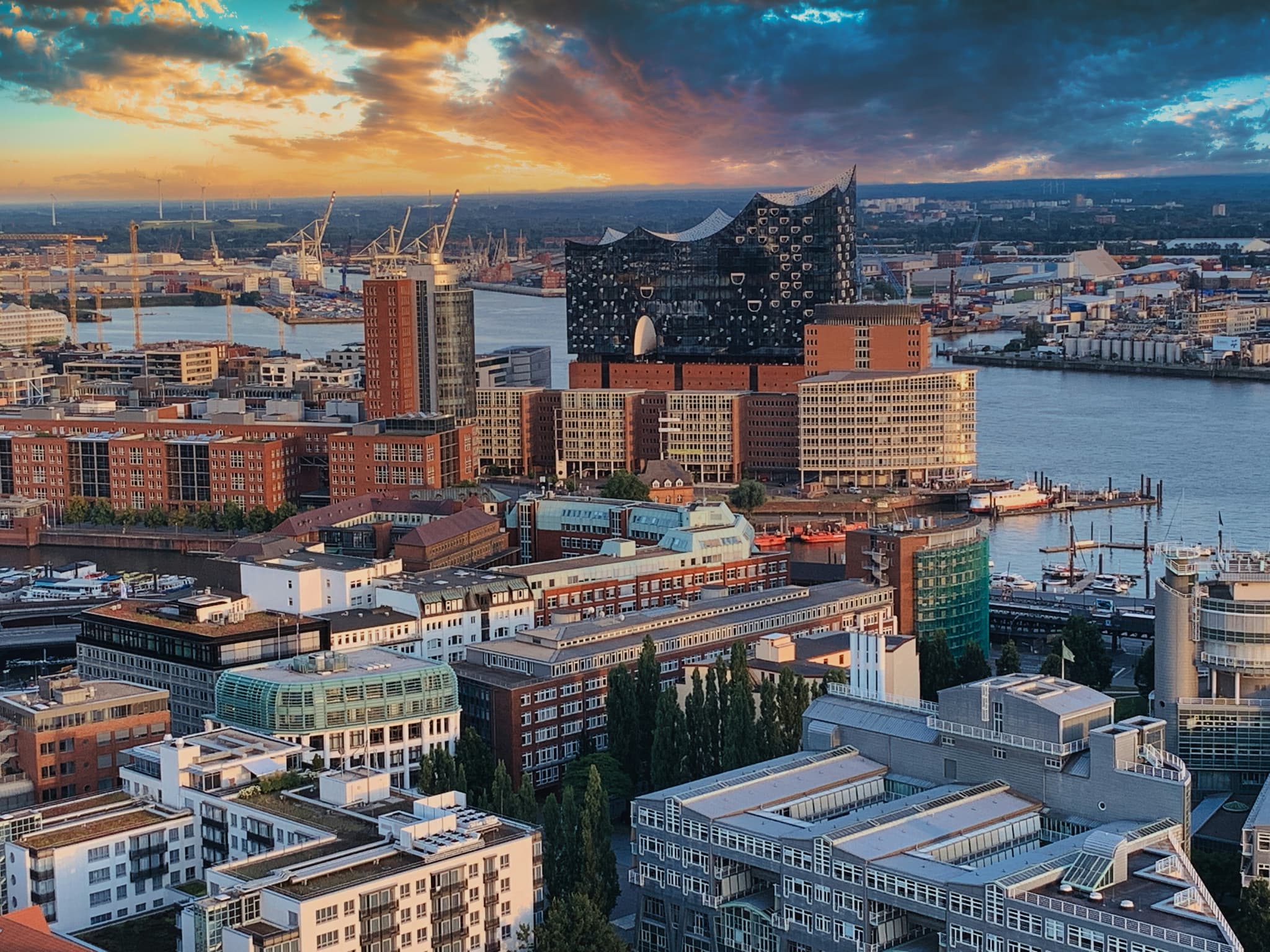
Hamburg is one of the most interesting office markets in Germany. City centre, HafenCity or City-Süd: find out which locations offer the best opportunities in 2025, what rents look like and what to watch for in a contract.